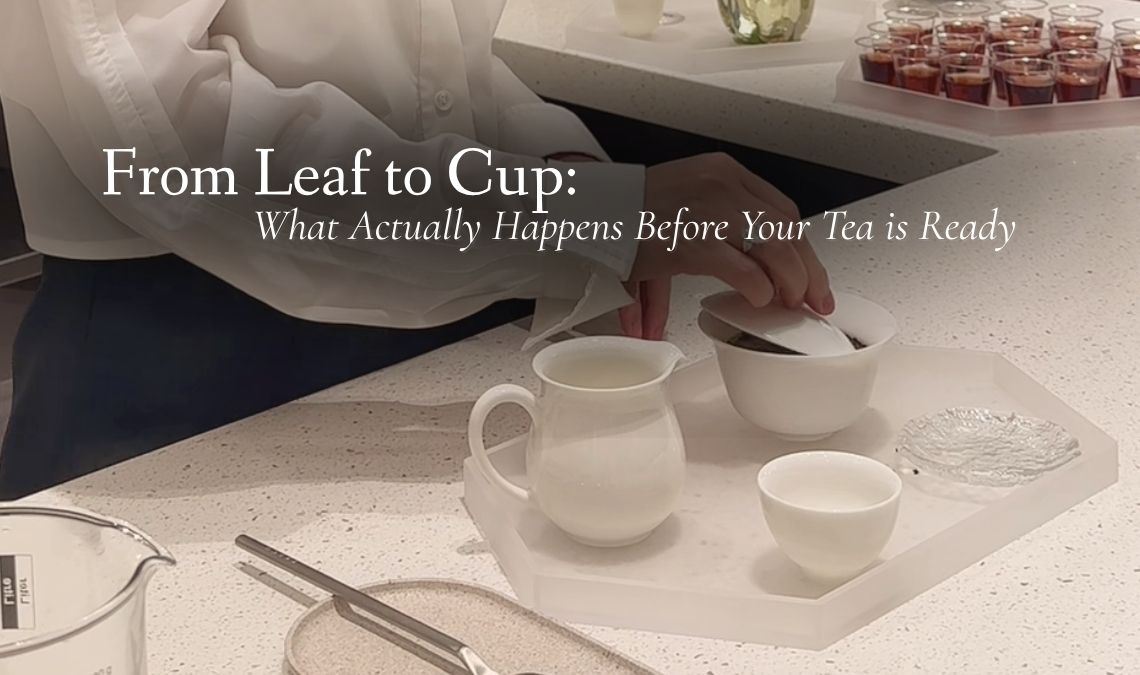
Most people have tasted tea. Very few have thought about what it took to make it.
That gap — between drinking and understanding — is exactly where Golden Seed lives. And nowhere is that gap more worth closing than in the question of how tea is made. Because the process isn’t simple. It isn’t fast. The decisions made at every stage — how long to wither, whether to oxidise, when to fire — are what determine whether what ends up in your cup is ordinary or extraordinary.
It Begins Before the Harvest
Long before anyone picks a leaf, the character of a tea is already being shaped. Altitude, soil composition, the angle of the hillside, the direction of morning fog — all of these contribute to what the Chinese call terroir. It’s the same concept wine lovers understand instinctively: place matters. A Long Jing grown in Hangzhou’s West Lake region and a green tea from elsewhere may share a species, but they don’t share a story.
Then comes the pick. For most fine teas, harvesting is done by hand — a bud and one or two leaves, selected with care. The earliest spring pickings (pre-Qingming, before the Qingming Festival in early April) are the most prized. At that point, the plant has stored energy through winter, and the new growth is tender, concentrated, and alive.
Step One: Withering
Once picked, the leaves begin to lose moisture almost immediately. This is withering — a controlled process where fresh leaves are spread out on bamboo trays or racks in a ventilated space, sometimes for hours, sometimes overnight.
Withering isn’t passive. It’s when enzymes in the leaf begin to activate. How much moisture is lost, and how quickly, will shape the flavour profile of everything that comes after. A heavily withered leaf produces a more complex, deeply flavoured tea. A lightly withered leaf retains more freshness and green character.
For green teas like Long Jing, withering is brief — the goal is to preserve that brightness. For oolongs and black teas, the wither is longer and more intentional.
Step Two: Kill-Green (or Let It Roll)
Here is where the paths diverge dramatically.
For green teas, after withering comes what the Chinese call shā qīng — kill-green. The leaves are exposed to high heat (traditionally in a wok, or in modern production, a large rotating drum) to stop enzymatic activity. This arrests oxidation entirely and locks in the green, fresh character of the leaf.
For oolongs and black teas, the leaves are instead rolled or tumbled — which bruises the leaf cells, exposes them to oxygen, and begins oxidation. The degree of oxidation is what places a tea on the spectrum between green and black. A lightly oxidised oolong might be 15–20% oxidised. A Taiwanese Da Hong Pao might reach 70%. A black tea is fully oxidised — the enzymes have done their full work.
Step Three: Rolling and Shaping
After kill-green or oxidation, the leaves are shaped. This is where a tea takes on its visual identity — the flat, sword-like profile of Long Jing; the tightly rolled pellets of Gunpowder green; the twisted, knotted forms of a high-mountain oolong.
Rolling isn’t merely aesthetic. It affects how the leaf releases its compounds during brewing — a tightly rolled tea opens slowly across multiple infusions, which is one reason gongfu-style brewing (short, repeated steeps) suits these teas so well. A flatter leaf like Long Jing releases more directly and quickly, which is why a glass vessel and a single, longer steep works beautifully.
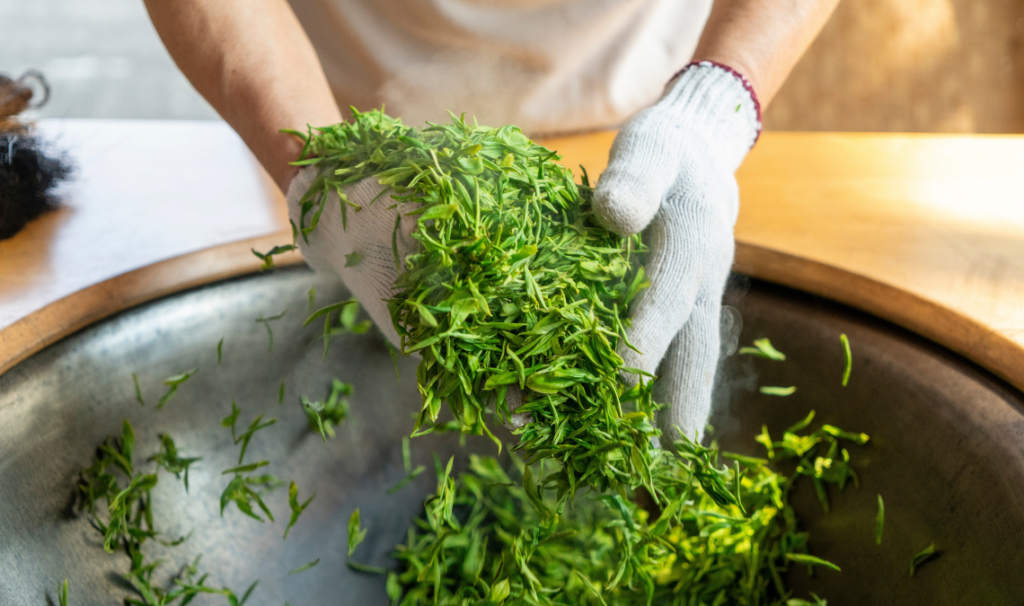
Step Four: Drying and, for Some Teas, Roasting
The final stage is drying — removing remaining moisture so the tea can be stored without degrading. For most teas, this is done in hot air ovens or drying machines. But for roasted teas like charcoal-fired Wuyi rock oolongs, this is a transformation of its own.
Roasting adds depth, smoothness, and a particular quality the Chinese call 火韵 (huǒ yùn) — fire character. The degree of roast can range from a light toasting that adds a soft warmth, to a deep charcoal roast that gives a tea mineral, charred edges and an almost coffee-like body.
For aged teas like Liu Bao, the process continues after production — the tea is stored in humid conditions where microbial activity slowly transforms it over years and decades into something richer, earthier, and more complex than any fresh processing could achieve.
Why This Matters for What You Taste
Understanding how tea is made doesn’t turn drinking into an exam. It does the opposite — it gives you a framework for noticing. When you taste the mineral clarity of a well-made Long Jing, you understand it’s the kill-green and the terroir speaking. When you encounter the smooth depth of an aged Liu Bao, you’re tasting time as much as anything else.
At Golden Seed Tea cafe Singapore, we spend considerable time understanding the production of every tea we source. Not as an academic exercise, but because it’s the difference between stocking a product and truly representing it.
If you’d like to have Authentic Tea Experience Singapore, our workshops include guided tastings across different tea types, with the production story woven into every cup. Details and bookings at https://www.goldenseed.mom/workshop