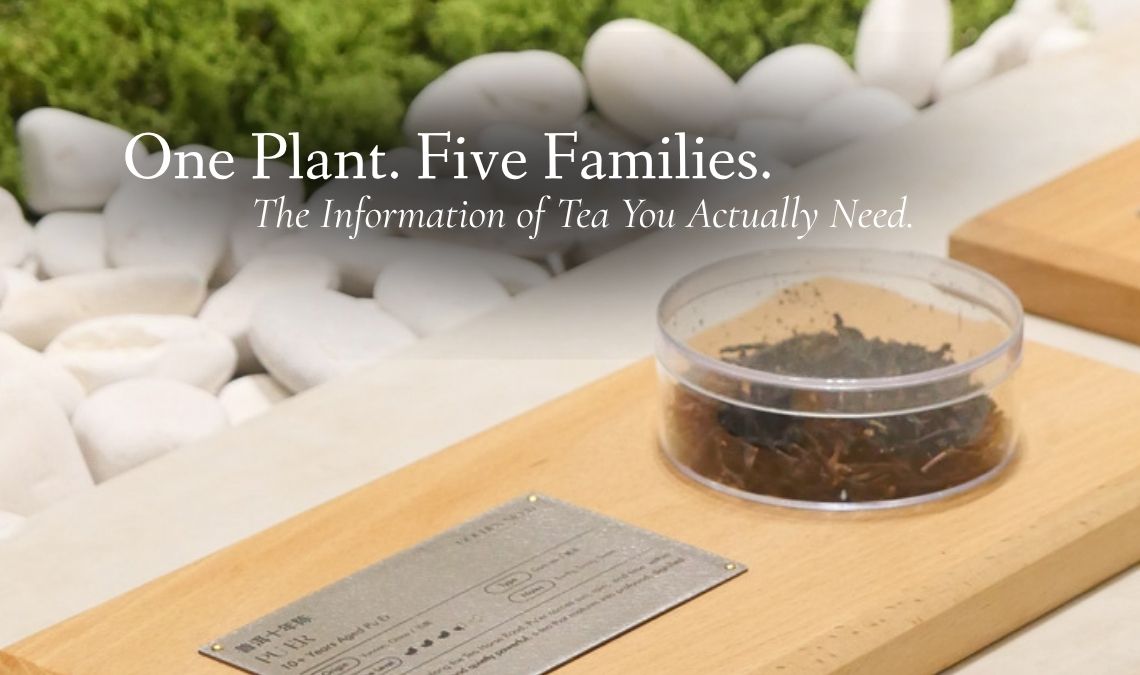
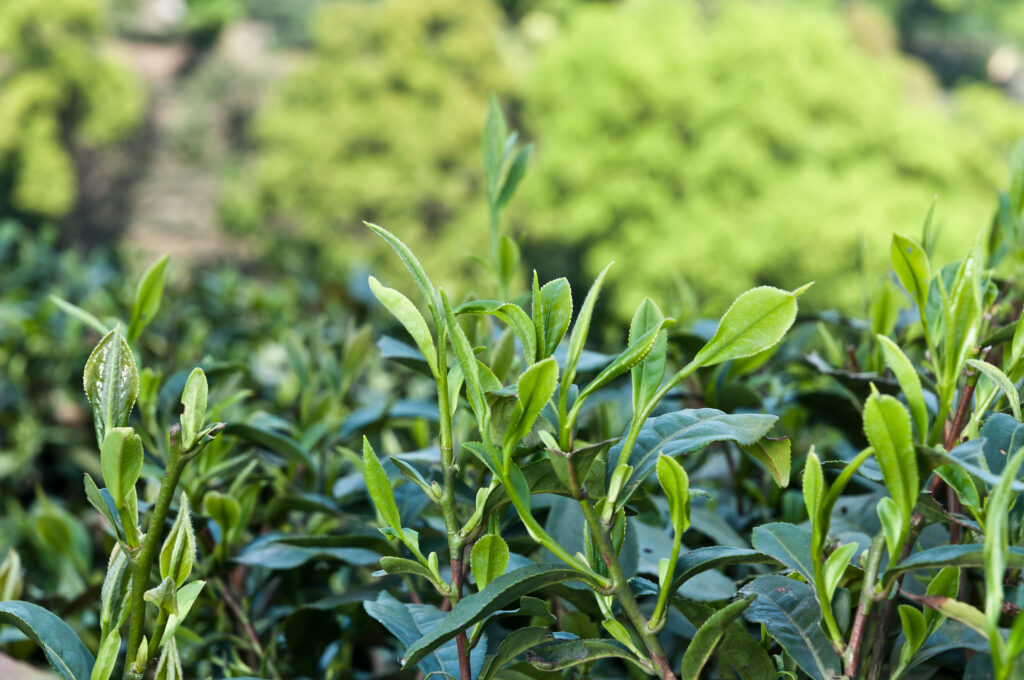
Every tea in the world — green, white, oolong, black, dark — comes from the same plant. Camellia sinensis. One species. One leaf.
The reason your morning Dragon Well and your evening Yunnan black taste like they belong to entirely different kingdoms is not the plant. It’s what happens to the leaf after it’s picked — the sequence of processing decisions that define each of the five tea families.
Green Tea — Unoxidised, Immediate, Alive
Green tea is the clearest expression of the fresh leaf. After picking, oxidation is stopped almost immediately through heat — either pan-fired (the Chinese method, which produces a toastier, more vegetal character) or steamed (the Japanese method, which produces a greener, more grassy result).
What you taste in a good green tea is brightness, freshness, and a kind of mineral clarity. The category spans an enormous range — and our specialty is Xi Hu Long Jing as the most prized Green tea.
Green teas are the most delicate of the five families. They’re sensitive to water temperature (never above 80°C), to steep time, and to age. Drink them fresh, treat them gently, and they reward you in kind.
White Tea — Minimal Intervention, Maximum Patience
White tea is perhaps the least processed of all five families. The leaves — typically young buds or bud-and-one-leaf sets — are simply withered and dried. No kill-green. No rolling. No roasting.
This restraint is deliberate. The goal is to let the natural compounds of the leaf express themselves with as little interference as possible. The result is a tea that tastes soft, delicate, and often floral — with a sweetness that comes from the downy buds themselves.
The most celebrated white teas come from Fujian province: Baihao Yinzhen (Silver Needle), made entirely from buds, and Baimudan (White Peony), which includes the first leaf alongside the bud. Like Liu Bao, quality white teas can also age beautifully — developing a honey-like depth over years.
Oolong — The Entire Spectrum in One Family
If green and black tea represent opposite ends of a spectrum, oolong occupies the vast middle ground — and it is easily the most complex of the five families in terms of the range it contains.
Oolongs are partially oxidised, somewhere between 15% and 85%. A lightly oxidised oolong (like a Taiwanese High Mountain Ali Shan) will taste closer to a fine green tea — fresh, floral, creamy. A heavily oxidised oolong (like a traditional Wuyi rock oolong) will taste closer to a complex black tea — mineral, roasted, with extraordinary layering across multiple infusions.
The rolling and shaping of oolongs — either into tight pellets or long, twisted strands — also affects the brewing experience significantly. Tightly rolled oolongs unfurl dramatically across 8 to 12 infusions, revealing different facets of the tea with each steep. This is exactly the kind of tea that gongfu brewing was designed for.
Black Tea — Full Oxidation, Full Body
Black tea is fully oxidised — the enzymatic process is allowed to run its complete course before the tea is dried. This produces the characteristic reddish-brown liquor (the Chinese name, hong cha, actually means ‘red tea’), bold body, and the tannin structure that makes black tea take milk so comfortably.
Within the family, the range is still considerable. A Darjeeling first flush is bright, muscatel, almost delicate. A Yunnan Dian Hong is rich, malty, sometimes with notes of dark chocolate or dried fruit. An Assam is robust, brisk, built for a long morning.
The finest black teas — including some high-grade Dian Hongs we occasionally carry at Golden Seed — are best drunk without milk, with the same attention you’d give a fine oolong.
Dark Tea — Time as an Ingredient
Dark tea is the fifth family, and the one most people haven’t encountered yet. It is post-fermented — which means microbial activity continues to transform the tea after processing, often over years and decades. Liu Bao, which we have written about in depth, belongs here. So does Pu-erh, the most widely known dark tea internationally.
The character of a good aged dark tea is unlike anything else in the five families: earthy, smooth, deeply complex, with a kind of mineral richness that can only come from time. The process cannot be rushed.
We carry a curated selection from this family at Golden Seed, with provenance we can trace and speak to in detail. If you’re curious where to begin, come in — or book a tasting session.
Where to Begin
If you’re new to exploring the Traditional Chinese tea in Singapore, you can do is taste them side by side — not to rank them, but to understand how the same leaf becomes five distinct experiences.
That’s exactly what our introductory workshops are designed for. No prior knowledge required. Just curiosity, and an afternoon to spare. To join our Tea workshop Singapore, bookings at https://www.goldenseed.mom/workshop